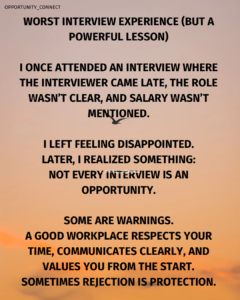
Worst Interview Experience: 7 Interview Red Flags Every Job Seeker Should Never Ignore
Many job seekers believe the interview process is simply about answering questions correctly and impressing the employer.
But what most people don’t realize is this:
An interview is a two-way evaluation.
While the employer is deciding whether you are a good fit, you are also deciding whether the organization deserves your time, skills, and energy.
Sometimes, what feels like a disappointing interview experience is actually a powerful signal that the opportunity may not be right for you.
Here are some common red flags from one of the worst interview experiences many professionals encounter—and what they truly mean.
1. The Interview Started Very Late Without Any Apology
Time is one of your most valuable resources as a professional.
When an interviewer arrives very late without explanation or apology, it often reflects how employees may be treated internally.
Organizations that respect candidates usually respect staff as well.
A simple delay can happen anywhere. But silence and disregard during delays often reveal something deeper—poor structure or lack of professionalism.
Pay attention to how you are treated before you are hired. It usually doesn’t improve afterward.
2. The Job Role Was Not Clearly Explained
One of the biggest warning signs during an interview is when the responsibilities keep changing as the conversation continues.
For example:
You applied for one role
You were interviewed for another
Then additional responsibilities appeared unexpectedly
When expectations are unclear from the beginning, the role can easily become stressful later.
Clarity during interviews often reflects clarity inside the workplace.
If the interviewer cannot clearly define what success in the role looks like, it may become difficult for you to succeed there.
3. Salary Conversations Were Avoided Completely
Many job seekers feel uncomfortable discussing salary early in the interview process.
But avoiding compensation conversations entirely is not a good sign.
Professional organizations understand that candidates need transparency to make informed decisions.
When salary details are hidden until the final stage—or not discussed at all—it may indicate:
Unclear budget structure
Internal approval issues
Or compensation below market expectations
Remember this:
Discussing salary is not being demanding.
It is being professional.
4. The Interview Felt One-Sided
Some interviews feel more like interrogations than conversations.
Instead of learning about your experience and goals, the interviewer only asks quick questions without explaining the organization, team culture, or expectations.
A healthy interview should feel like a discussion—not an interrogation.
Strong organizations use interviews to introduce candidates to their mission, values, and growth opportunities.
If the conversation feels rushed or one-sided, it may reflect workplace communication culture.
5. There Was No Structure to the Interview Process
A structured interview usually includes:
Clear introduction
Defined role explanation
Opportunity for candidate questions
Explanation of next steps
When interviews feel disorganized or confusing, it may indicate internal coordination challenges within the organization.
Structure during recruitment often reflects structure inside daily operations.
And structure matters more than many job seekers realize.
6. You Were Asked to Perform Unpaid Tasks Without Clear Expectations
Some organizations request tasks during interviews to evaluate candidates.
This is normal.
However, when assignments become excessive or unclear—and there is no feedback afterward—it becomes concerning.
Professional organizations respect candidates’ effort and provide clarity around expectations.
Your time and skill are valuable even before employment begins.
7. There Was No Feedback After Multiple Interview Stages
One of the most frustrating interview experiences is completing several interview rounds and receiving no response afterward.
While delays sometimes happen, complete silence often shows weak communication systems.
Organizations that value people usually communicate decisions—even when the outcome is not successful.
Feedback shows professionalism.
Silence often shows the opposite.
The Most Important Lesson From a Bad Interview Experience
Not every interview experience is meant to lead to employment.
Some interviews are meant to teach awareness.
Sometimes they reveal:
What to avoid
What questions to ask next time
What standards you should never lower again
And sometimes, they protect you from entering the wrong environment.
As a job seeker or young professional, it is important to remember this:
You are not just trying to get hired.
You are choosing where your energy, time, and skills will grow.
The right workplace will communicate clearly.
Respect your time.
Explain expectations honestly.
And value your contribution from the very first interaction.
Because the best interviews don’t just make employers confident in you.
They also make you confident in them.